
Greek And Roman Deities On Coins-23
2026-02-07 Sat
In #ancient #Greek religion, Tyche is honored as the goddess and personification of good #Fortune, #chance, and luck. She is considered the child of the #Titans Tethys and Oceanus, who are both linked to freshwater. Tyche was believed to bring positive signs about #events beyond a person’s control. Her #Roman counterpart is the goddess Fortuna.Tyche has appeared in many art forms and is easily recognized by her #mural #Crown, which symbolizes #City walls, towers, or fortifications; a rudder, signifying control and direction; and the cornucopia she holds. The mural crown identifies her as the goddess of the city. Her image first started appearing on coins in the 4th century BCE.
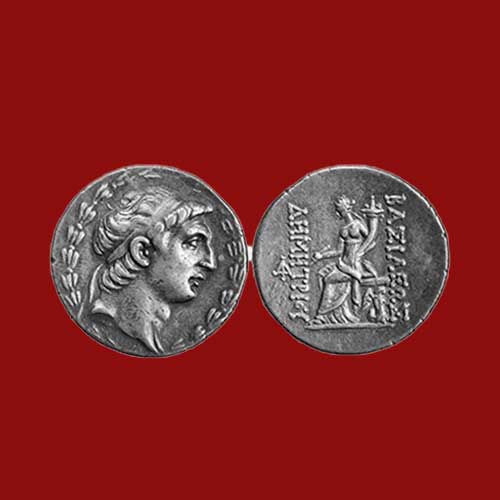
The coin featured in this post is a #Silver Tetradrachm of Demetrius I Soter, minted between 162 BCE and 150 BCE in Antioch, an ancient Greek city in modern-day #Turkey. With a dia of 31 mm and a weight of 16.69 grams, the obverse of the coin shows a diademed head of Demetrius I facing right within a laurel wreath. The reverse depicts Tyche, fully draped, holding a sceptre in her right hand and a cornucopia in her left, seated to the left on a #Throne with a winged figure beneath. A monogram also appears in the outer field to the left. The Greek #Legend on the coin, ‘BASILEOS DEMETRIOY,’ translates to ‘King Demetrios.’
Demetrius I Soter, often called Demetrius the 'Saviour', was Emperor of the Hellenistic Seleucid #Empire during the 2nd century BCE. He famously escaped Roman captivity and took the #Syrian throne from his cousin Antiochus V. He received the title "Soter" from the Babylonians, whom he freed from the harsh #Rule of Timarchus, a Greek noble and satrap of the Seleucid Empire.
Latest News
-
Extremely Rare Silver Quarter Tanka of Kachar Monarch Yasho Narayan, Owing Allegiance to Ghatotkacha Lineage
2026-06-23 TueHidden within the misty valleys and forested hills of Northeast India lies the story of the Kacha...
-
Gun and Sword on Silver Katra Taka of Independent Kingdom of Jaintiapur King Bar Gossain II
2026-06-22 MonThe Jaintia was a prominent medieval Independent Kingdom in Northeast India, ruled ...
-
Rare and Beautiful Gold Dinar of Gauda Ruler Shashanka
2026-06-19 FriThe Gauda dynasty was an ancient kingdom in the Gauda region of Bengal. It emerged as an independ...
-
Exceptional Gold Mohur of Ahom King Swargdeo Rajeshwar Singha
2026-06-19 FriThe Ahoms were ethnic group originating from the Tai people and founder of Assamese royal dynasty...
-
Heavy Lead Coin of Hiranyakas, King Khadakama
2026-06-18 ThuThe Hiranyakas were a local dynasty that rose in the mid-3rd century CE, in Rayalaseema region th...